

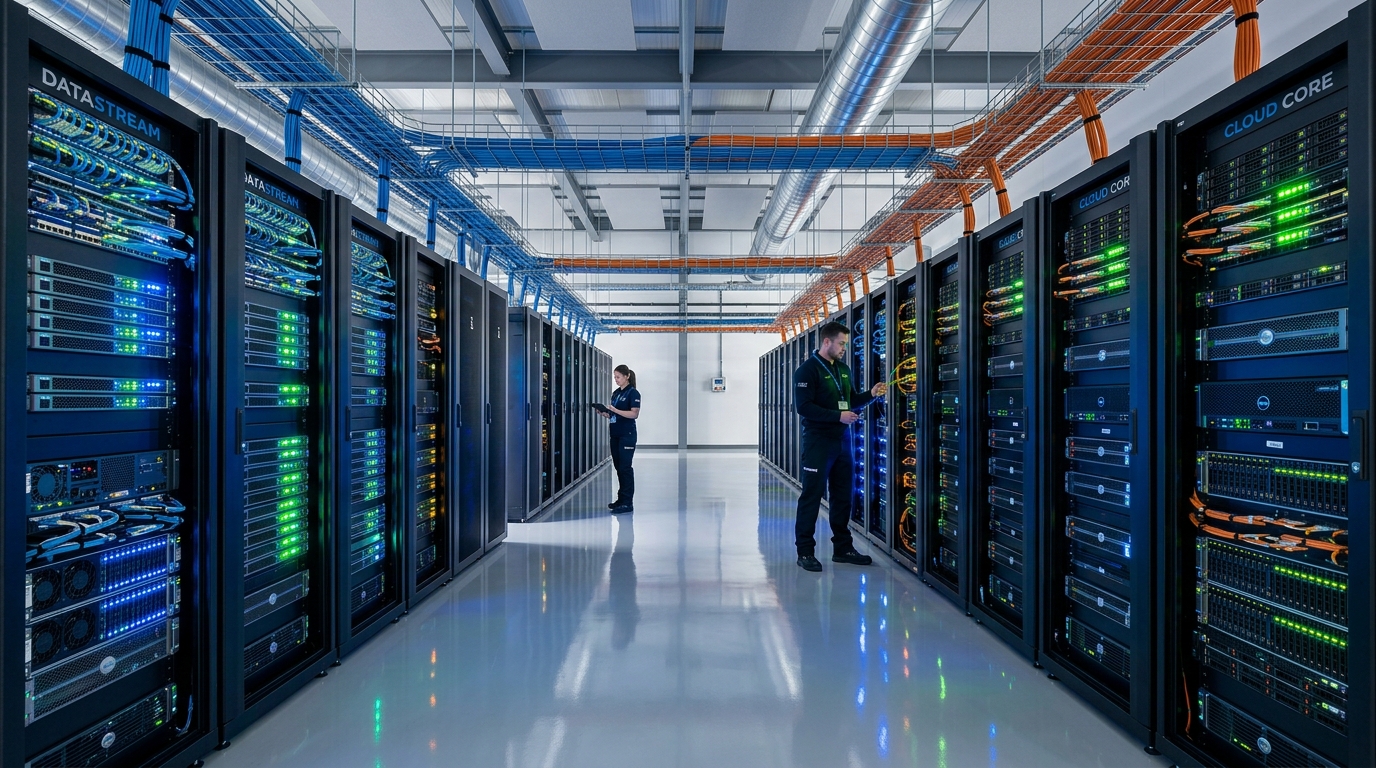
Executive Briefing
- Analyze the economic and architectural drivers behind migrating heavy AI/ML pipelines from legacy hyperscalers like AWS to Oracle Cloud Infrastructure (OCI).
- Examine networking bottlenecks, inter-region egress fees, and GPU cluster performance trade-offs using RDMA over Converged Ethernet (RoCE v2).
- Review actionable migration checklists and total cost of ownership (TCO) benchmarks for enterprise-scale predictive maintenance models.
As enterprise machine learning models scale into billions of parameters, infrastructure expenditure often threatens to outpace top-line growth. For organizations running continuous, compute-intensive AI workloads – such as Nanoprecise’s automated industrial IoT predictive maintenance systems – cloud egress fees, legacy GPU provisioning models, and complex egress structures can severely compress operational margins. The recent industry shift of migrating core AI training and inferencing workloads from Amazon Web Services (AWS) to Oracle Cloud Infrastructure (OCI) highlights a broader architectural awakening among enterprise engineering leaders.
The Economic and Architectural Bottlenecks of Legacy Hyperscalers
When engineering teams initially prototype deep learning algorithms or computer vision models, hyperscalers like AWS provide unmatched operational convenience. Services like Amazon SageMaker and EC2 instances featuring NVIDIA A100 or H100 GPUs simplify rapid deployment. However, at scale, structural economic friction emerges:
- Data Egress Penalties: Continuous streaming of telemetry, IoT sensor streams, and high-frequency time-series data across availability zones and out to hybrid endpoints incurs punishing bandwidth fees.
- GPU Cluster Contention: Multi-node distributed training requires ultra-low latency, high-bandwidth fabric. Standard public cloud virtualized networks often experience tail latency issues that degrade scaling efficiency.
- Predictable Cost Disparities: Standardized hourly pricing models on AWS fail to account for sustained, 24/7 industrial analytics workloads, driving up long-term Total Cost of Ownership (TCO).
Why OCI Reshapes Enterprise AI Economics
Oracle Cloud Infrastructure has aggressively positioned itself as an enterprise-grade powerhouse for high-performance computing (HPC) and artificial intelligence workloads. By utilizing a radically flat network topology and bare-metal GPU instances paired with RDMA over Converged Ethernet (RoCE v2), OCI eliminates the noisy-neighbor virtualization tax common in legacy clouds.
For data-intensive platforms requiring real-time anomaly detection, OCI delivers near-linear scaling efficiency during distributed training clusters. Furthermore, its aggressive data egress pricing model allows enterprises to ingest vast telemetry datasets without incurring punitive transfer penalties.
Custom Enterprise Software & Cloud Modernization
Partner with InfusionicSoft to architect high-performance cloud applications, API microservices, and bespoke enterprise systems.
Migration Implementation Checklist for AI Workloads
Executing a seamless cloud migration for production-grade machine learning pipelines requires methodical decoupling of compute, storage, and networking layers. Use the following structured checklist to de-risk your cloud migration:
| Phase | Key Engineering Tasks | Risk Mitigation |
|---|---|---|
| 1. Assessment & Profiling | Audit GPU memory footprints, I/O bottlenecks, and dataset egress volumes. | Identify hidden API dependencies and proprietary managed service lock-ins. |
| 2. Network Topology Design | Configure OCI Virtual Cloud Networks (VCNs) and provision RoCE v2 subnets. | Ensure inter-node latency remains under 2 microseconds for distributed training. |
| 3. Data Tiering & Sync | Migrate object storage data lakes utilizing high-speed parallel transfer utilities. | Implement dual-write patterns during validation phases to prevent data drift. |
| 4. Cutover & Validation | Shift containerized inference endpoints (Kubernetes/OKE) and monitor SLA parity. | Maintain active-passive fallback instances on AWS until throughput stability is proven. |
Enterprise FAQ
How does OCI achieve lower GPU compute costs compared to AWS?
OCI optimizes hardware delivery through highly efficient server architectures and lower virtualization overhead. Additionally, Oracle’s aggressive pricing strategy on bare-metal GPU clusters and minimal data egress fees substantially reduce the cumulative monthly bill for data-heavy AI operations.
What are the primary networking requirements for migrating distributed AI training?
Distributed deep learning demands ultra-low network latency between GPU nodes. OCI utilizes RDMA over Converged Ethernet (RoCE v2) across bare-metal instances, bypassing the operating system kernel stack to deliver microsecond-level latency comparable to on-premises supercomputers.
How can enterprises prevent downtime during a multi-cloud migration?
A phased decoupling strategy – moving containerized inference workloads first while keeping legacy data pipelines mirrored via asynchronous replication – ensures zero-downtime cutovers and continuous SLA compliance.

